This presentation by *Kris Nelson* serves as an introductory deep dive into Metaphysics, Language, and Reality through the framework of the Trivium Method. The session utilizes approximately 20 custom infographics to help simplify complex philosophical concepts related to consciousness and existence.
### Key Concepts Covered:
* The Trivium and Reality: The speaker emphasizes that the seven liberal arts (Trivium and Quadrivium) are essential tools for understanding existence and moving toward conscious, causal action in the world (0:48 – 2:31).
* Matter and Form: A recurring theme is the relationship between potential matter and actualizing form. The speaker explains that *form* acts as the blueprint or “morphogenetic field” that organizes matter into specific entities (26:58 – 28:02, 1:14:19 – 1:15:42).
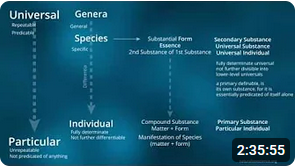
* Particulars vs. Universals: The presentation distinguishes between *particulars* (the specific, concrete objects we encounter in time and space) and *universals* (the concepts, essences, and definitions we abstract from reality). Symbols and language are presented as the essential bridge between these two states (37:09 – 38:31, 53:17 – 55:20).
* The Ten Categories of Being: The speaker outlines *Aristotle’s* categories, categorizing existence into substance (what a thing is) and accidents (the properties, qualities, and relations of a thing), explaining how these relate to logical predication (1:01:54 – 1:13:46).
* Predication and Logic: The latter half of the video details essential predication (describing things within their category) and accidental predication (crossing categories to relate properties to substances). This is illustrated through examples involving human and non-human animal classifications (1:44:34 – 1:53:22, 1:57:25 – 2:01:41).
### Conclusion and Philosophy:
* The speaker argues that developing the ability to think clearly—through the study of logic and the Trivium—is necessary to navigate reality accurately, avoid fallacies (like misinterpreting quantum physics), and distinguish between different orders of life (e.g., plants vs. animals) (2:33:04 – 2:35:28).